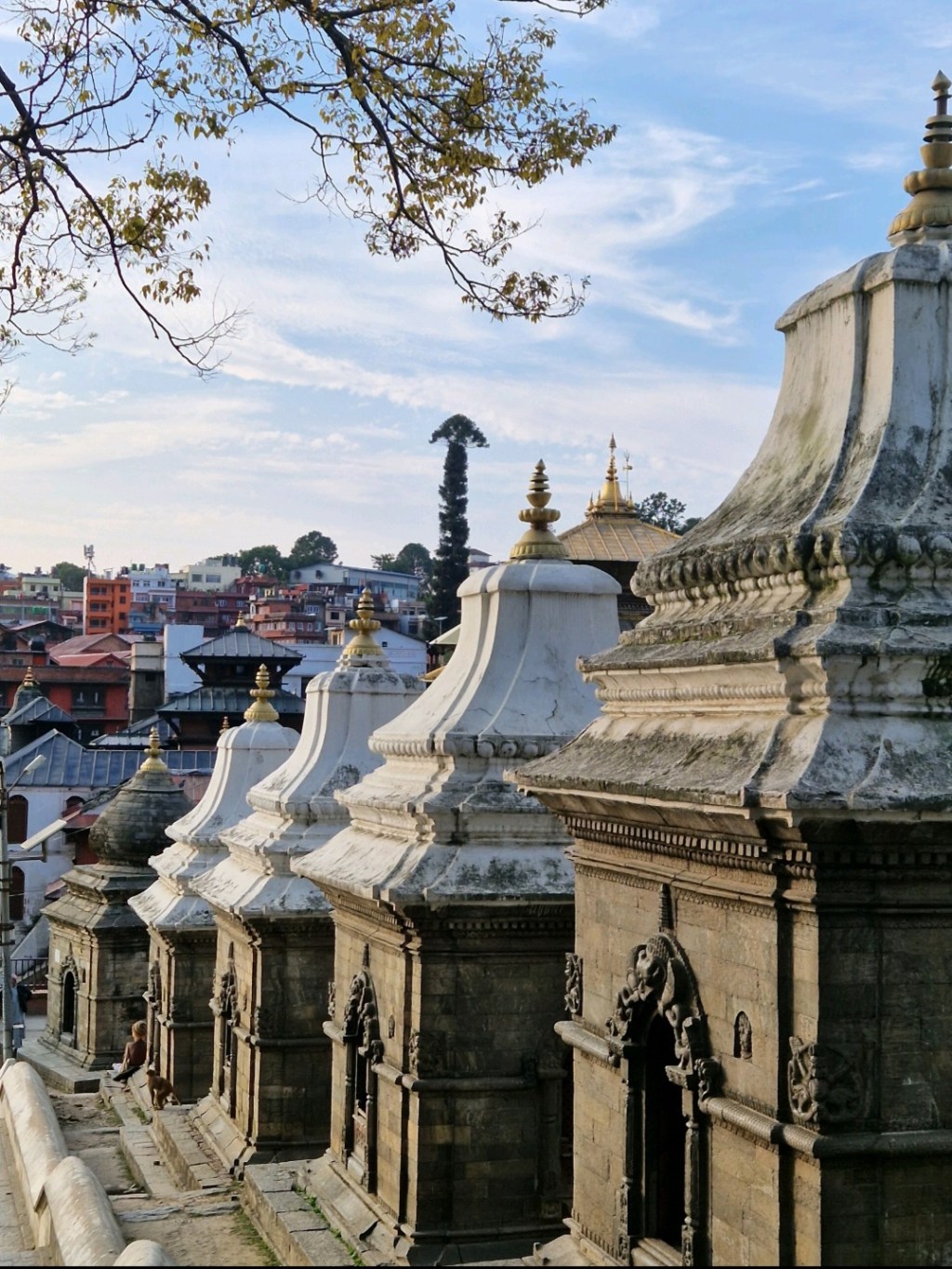

To outsiders, Pashupatinath is known primarily as a place where open air cremations take place. I like to experience as much as I can when travelling, whether that’s culturally comfortable for me or not, so I was keen to visit to learn more about life and death in Nepal. Others in our party decided it wasn’t for them, and some had already been, so it was a group of five of us who braved taxis and traffic, and made our way across the city to the Bagmati River.
Pashupatinath Temple stands on the banks of the Bagmati River in Kathmandu. There has been a temple dedicated to Shiva on this site since 879AD. Built in its current form in around 1692, it was given UNESCO World Heritage Site status in 1979. The oldest Hindu Temple in Nepal, this is a site of historical, religious and cultural significance, and a place of pilgrimage. The temple itself is accessible only if you’re Hindu, but the grounds are open to all. Locals and worshippers get in free of charge, tourists are charged 1000 NPR. You must keep your ticket on you, and show it if asked. If you have spent time in Kathmandu, it will come as no surprise that there is also a statue of Buddha here. Hinduism and Buddhism are tightly entwined, and most religious sites around Nepal have relevance to both religions, particularly in Kathmandu.

In the grounds you can find 518 temples, varying in size and age, including the Guhyeshwari Temple, which is mentioned in an 11th Century manuscript. Pashupatinath, as mentioned above, is also where families come to cremate their deceased loved ones, one of the holiest sites to do so. The belief is that being cremated here, near the temple dedicated to Shiva, is a sure way to enter the next life in human form. Only royalty may be cremated in front of the temple, and which ghat a person is cremated on depends on their status. The majority are cremated on the ghats west of the bridge, while people of certain status, such as dignitaries, military, religious officials etc., may be cremated east of the bridge, closer to the temple itself. On the way in there is a religious market which, as well as catering for pilgrims and worshippers, has all that’s needed to send a loved one on their way, shrouds, rice, marigold garlands, it’s a one stop shop. As cremation must be carried out swiftly after death, this seems quite an efficient way to handle it. There is a cornea donation centre beside the temple too, making it as straightforward as possible for families.
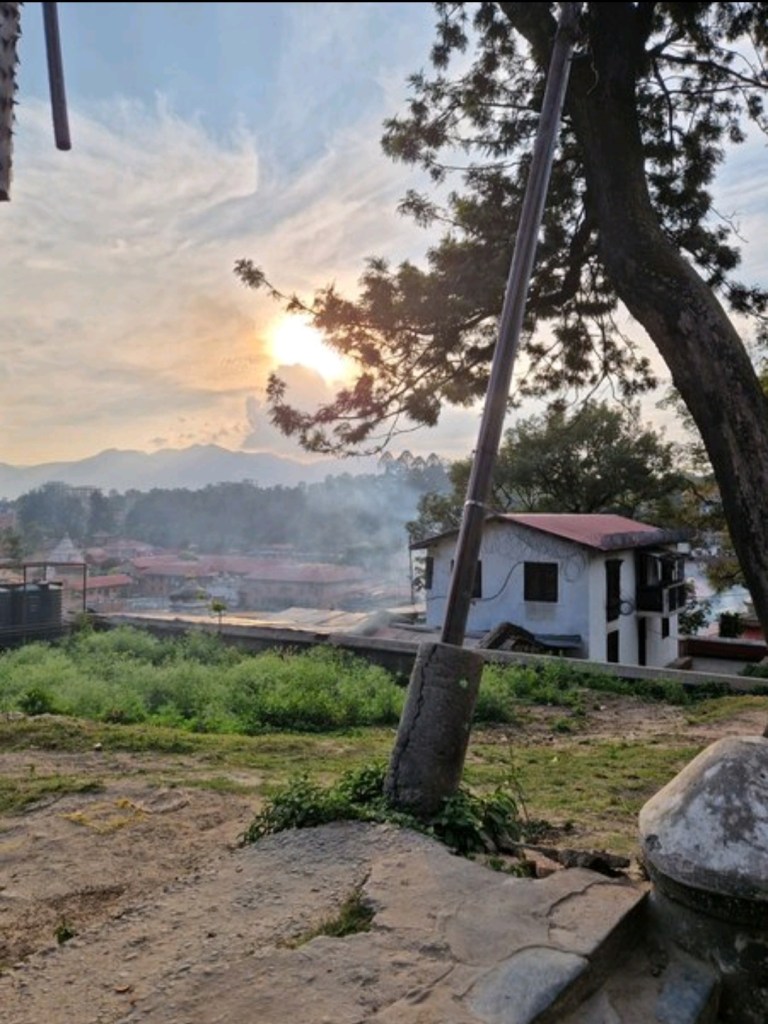
As you would expect, since there are constantly burning pyres, there is a smoky haze that hangs over the complex. It doesn’t smell unpleasant, but it’s a good idea to bring something to cover your face, and a bottle of water in case the smoke catches in your throat. There are plenty of people selling water though, (as well as various trinkets) so if you do find yourself in the midst of a coughing fit, help is at hand, for a price.
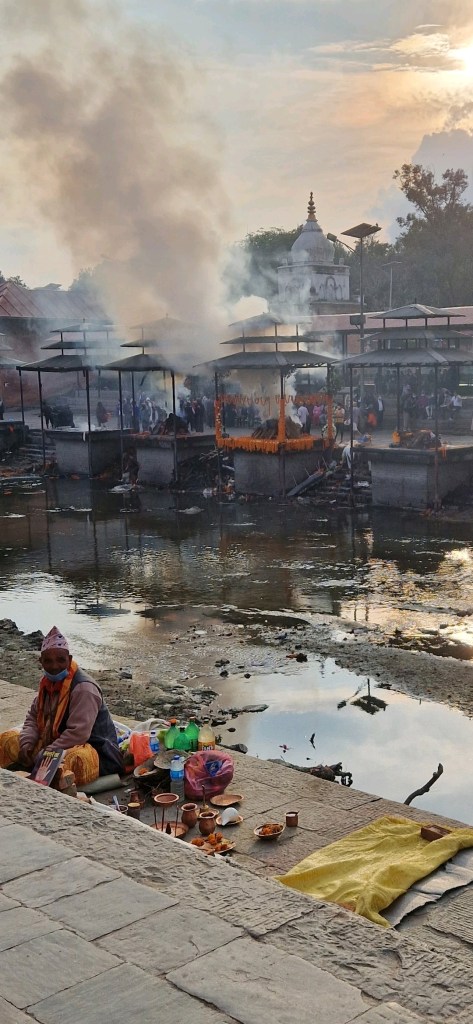
Crossing one of the bridges across the river, we climbed the steps to take in the view. Over this side are numerous small temples and shrines, monkeys scampering over them, and Sadhus sitting in front of them.
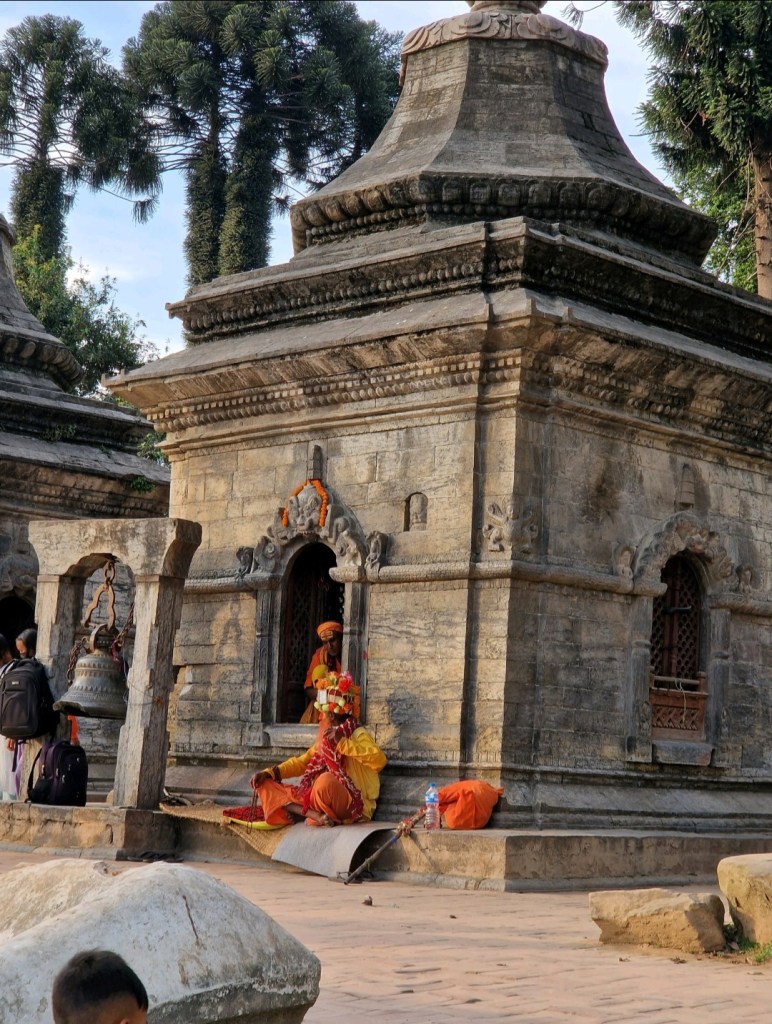
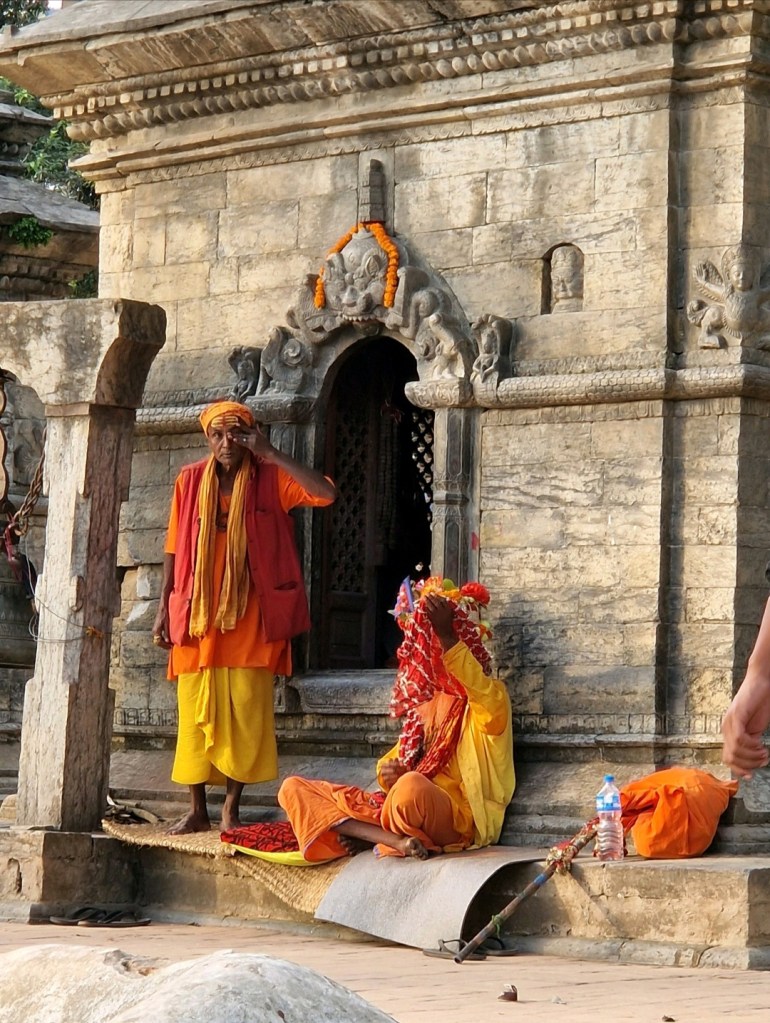
These vibrantly-coloured Hindu holy men, draped in red, orange and yellow, have stepped outside of society. Traditionally, they take vows, those of celibacy, humility, detachment, and aversion to wealth and taste, but unlike monks who belong to a particular order, these men (and sometimes women) go solo, relying on the kindness of others to survive. They often lead a nomadic existence. They will either cover their faces, or ask for alms if you wish to photograph them, and will happily chat.
As afternoon faded to evening, there were noticeably more people arriving, gathering for the Sandhya Aarati. This ritual takes place at 7pm each day, and features music, mantras, lamps and bells, and is performed by the priests from the temple. While I would have liked to stay and see this, we needed to be on our way.

However, as we made our way towards the bridge, a man arrived on a stretcher, to the east of the bridge, covered with white cloth. We decided to stay a while longer, as although we had seen the cremations in progress on the other side of the bridge, they were already in full swing by the time we arrived. This was a chance to see the ritual from the beginning. From across the river, we watched as the men of the family discreetly undressed him and discarded his clothes. They collected water from the river, washed his feet and his face, then placed him on a bamboo stretcher which was carried to the platform. He was draped in orange cloth with his head exposed, and the eldest son walked clockwise around him, sprinkling rice, pigments, incense, and various other things we couldn’t distinguish. Other members of the family did the same. It looked as if everyone had a set job to do. Once the deceased was placed on the logs, and more rituals had been carried out, including anointing the man’s face with oil, his son was handed a lit piece of wood. As he put this at his father’s head (the soul is believed to leave the body through the mouth) a Gorkhali soldier played The Last Post. Four Gorkhali soldiers had overseen the ceremony from the opposite bank of the river, I assumed the deceased had served in the armed forces.

As the pyre began to burn, straw was placed over the body, giving off thick white smoke. The family comforted each other as they said their goodbyes. It was a sombre moment, but to witness it didn’t feel intrusive or ghoulish, it felt like we too were honouring this departed soul. In Hinduism, death is not the end, it’s a step into the next stage on the journey to enlightenment. It’s very much a part of life, and the thread of impermanence is woven through every facet of life in Nepal.
Downstream, ashes were swept off a ghat into the river, on their way to the Ganges. Smoke rose to the heavens. Monkeys scurried, cattle grazed, life went on.
 Jayne Loves Adventures
Leave a comment