Prepare for the worst, hope for the best. That’s the way I tackle any adventure, so when I booked a trek to Everest Base Camp, I was obviously going to do a bit of research. There’s a plethora of information out there, but for every bit of advice, there’s conflicting information, so it can be hard to know what to believe, and what will be relevant to you, especially if it’s your first foray into high altitude adventures.
I read books, blogs, watched vlogs, talked to many people who had been on this trip, and by the time I’d done all that, my head was spinning with information overload, and I had no idea where to start. The endless kit lists, while comprehensive, seemed incompatible with the 15kg weight limit imposed on flights to Lukla. Kit, medication, and must-have items are all very much down to the individual, what I would class as essential may not even be on someone else’s list, so I’m not going to dictate what you should or shouldn’t take, or indeed what you should or shouldn’t do on your trek, instead I will share the mistakes I made. You can have a good laugh at my expense, and hopefully learn from them so you don’t end up in a pickle.
There’s no such thing as bad weather, only unsuitable clothing.
Alfred Wainwright
Kit
As the great man knew, the right kit will see you through most situations, and what those situations might be very much depends on the time of year. I don’t recall any issues that were down to kit selection, but if I were to do the trek again, I would pack less. I agonised beforehand about how many pairs of knickers to take, what my fleeces weighed, and whether four pairs of trekking trousers would be enough. Of the four pairs I took, I wore three, and one of those I only wore around Namche Bazar while my favourite pair was being washed. If you’re putting it in ‘just in case,’ ditch it.
Preparation
You may think I’ve got the order wrong here, that preparation should come before kit, but much of this involves kit. Wearing in your boots, getting used to carrying your pack, and knowing where to put everything in your pack so you can lay your hands on it easily when the fog of altitude kicks in. Have you checked that your raincoat fits comfortably when you’re wearing extra layers? Do you know how to put the raincover on your pack? Trying to figure these things out on the side of a mountain in lashing rain is not the one, trust me. Above all, always keep your imodium on you. You really don’t want to be clenching with every step down unevenly-hewn rocky stairs because you put it in your duffel and your porter is 10km ahead of you. Don’t ask me how I know that, I just do. Ahem.
Training
I’d love to tell you I trained avidly before the trek. In reality, I kept injuring myself, so my training consisted of regular walks and time on a spin bike, all undertaken with the aim of not breaking any more bits of myself before departure day. In an ideal world, I would have spent more time in the gym, and incorporated a lot more stairs into my walks. Preferably rocky, uneven ones. My knees would have thanked me, if they hadn’t been squabbling over whose turn it was to be ‘the bad knee’.
Hydration
It’s the general consensus that, when at altitude, staying hydrated is absolutely vital. If you’re taking Diamox/Acetazolamide, it’s recommended that you drink at least a million gallons a day (this may be a slight exaggeration, but it felt like a million gallons). This is something I really struggle with at home, and having been assured it would come naturally when the need arose, I wasn’t prepared for it when my appetite left, taking thirst along with it. I had nuun tablets with me, but unfortunately, due to an ongoing supply issue, I only had one flavour, which I went off quite quickly. Even the taste of water made me queasy. I tried to supplement with bottles of Sprite, but it wasn’t enough. My big mistake here was that I forgot to pack concentrated squash. Even a little bit of dehydration affects you much more at altitude than it does at sea level. In Dingboche I felt almost as if I had sunstroke. My roomie kindly let me use some of her squash so I could get some fluids in, and she even brought me some cake back from a bakery to try and stimulate my appetite. Without those two things, I don’t think I’d have got any further, and I am immensely grateful to her for her kindness.
Food
Pictured: Mocha and cheesecake at a bakery in Namche. Way nicer than coleslaw pizza.
I’m a very good eater. I’m known for it. Therefore, it came as a huge surprise when my appetite deserted me. Now, it may be obvious to anyone with a couple of braincells to keep each other company, but to trek up hill and down dale (Nepali flat is a special kind of flat) you must be adequately fuelled up. Simple. Until you’re sitting in front of a plate of noodles for the fifth night in a row, your insides are churning, and you can’t force more than a few mouthfuls in. The thing is, if you feel rubbish, you don’t want to eat, which in turn makes you feel more rubbish. If you’re generally an omnivore, the lack of protein can also shock your system a little. I made a few mistakes with this.
I should have cut out meat for a couple of weeks beforehand.
I should have eaten more of a variety of foods.
I should have packed a mix of sweet and salty snacks.
I wish I had checked what the vegetables were before ordering a vegetable pizza. Coleslaw. It was a coleslaw pizza.
Ordering milky drinks after a week without any is not a good idea if you are lactose intolerant, and up a mountain with limited facilities.
Luxury Items
When I say luxury, understand that this is in the context of being at high altitude. We’re not talking footspas and caviar here. We’re talking about those little items that aren’t essential, but make your life a little bit more comfortable.
I used a lot of hand sanitiser, by the end of the trek, my hands were coated in residue, and I couldn’t get rid of the taste of it. Next time I do anything like this, I will take a small bar of soap to wash my hands with. My roomie had a small collapsible bowl, which she used when cleaning her teeth. It’s a faff, cleaning your teeth with bottled water, but necessary. The bowl meant she didn’t waste too much of it.
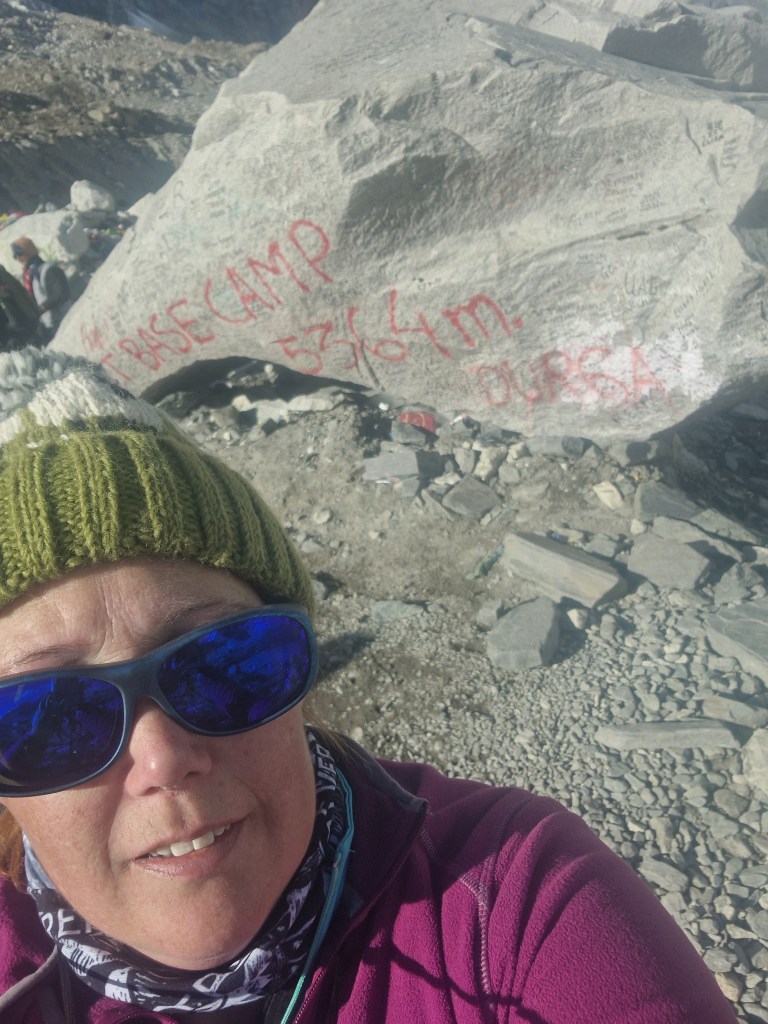
One thing I forgot, which I meant to take, was a little treat to enjoy at base camp.
A favourite snack, a small drink, whatever floats your boat, just a little something to treat yourself as you say, ‘I MADE IT!’
May I recommend powdered cordial rather than your standard concentrate? We picked some up in Kathmandu to mask the taste of the purification tablets we used in our water. Gram for gram it flavours more water 👍🏼
That’s a great shout! It’s also a good excuse to go and have a nosey in food shops. I love doing that when visiting other countries. Pizza-flavoured ramen and clove-flavoured toothpaste were my finds in Kathmandu.




 Jayne Loves Adventures
Leave a comment